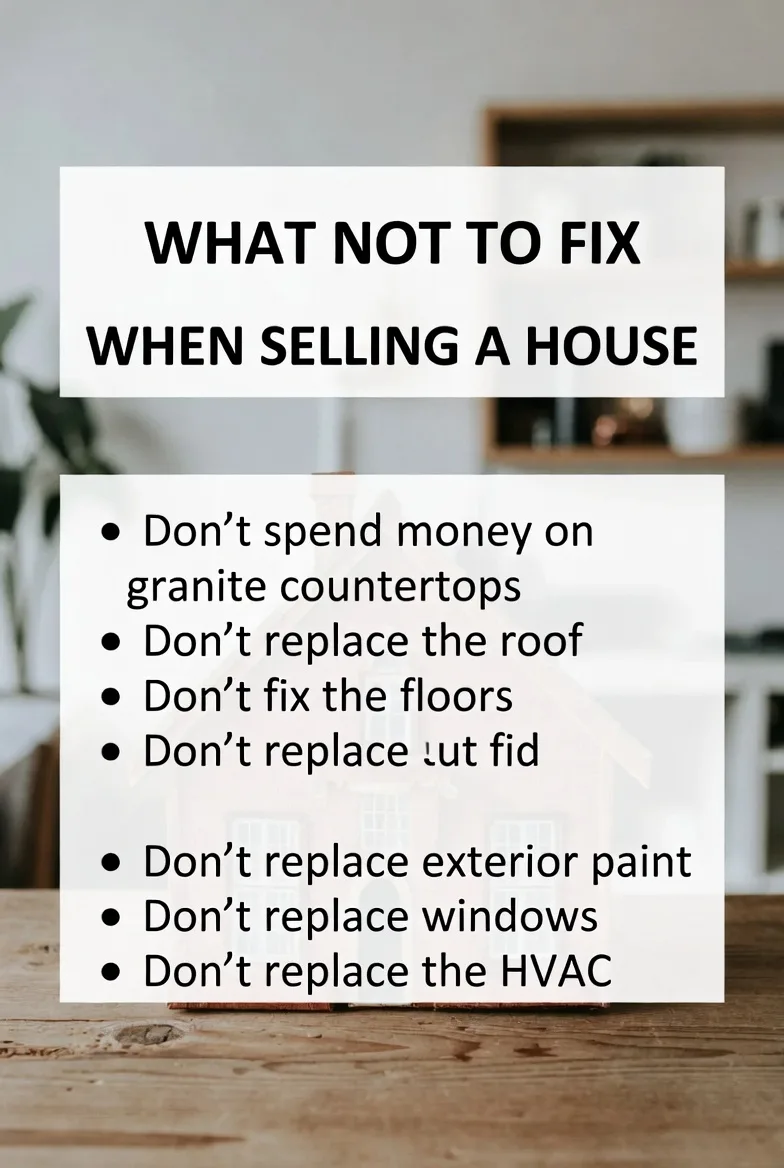
Hey, it’s your brutally honest real estate agent friend here. Last month I watched a seller drop $42,000 gutting two perfectly functional bathrooms—new tile, frameless glass showers, the works. Three weeks after closing, the buyer ripped it all out because they wanted matte black fixtures instead of their dreams. Forty-two grand—gone. Poof.
I’m tired of seeing good people flush five- and six-figure checks down the toilet trying to create someone else’s dream home. So today I’m spilling the exact repairs and upgrades 90 % of sellers waste money on—backed by hard numbers from the home-improvement shows will never tell you.
Skip these 10 money pits and you’ll pocket thousands (sometimes tens of thousands) more at closing. Ready? Let’s go.
1. Full Kitchen Remodels – The #1 Wealth Destroyer
- Average cost: $35,000–$75,000 (mid-range)
- Average added value: $18,000–$30,000 (2024–2025 Cost vs. Value Report)
- ROI: 38–54 %
I’ve seen sellers spend $68,000 on white shaker cabinets, quartz counters, and a $6,000 range… only to have the buyer negotiate $4,000 more on the offer. Net loss: $64,000.
Buyers care about a clean, functional, updated kitchen—but they almost always plan to redo it to their taste anyway. Unless your kitchen is literally from 1978 with avocado appliances and broken cabinets, skip the full remodel.
Exception: If cabinets are falling off the hinges or countertops are burned/delaminated, do a light refresh (paint cabinets, new hardware, new quartz or butcher block, new sink/faucet) for $6,000–$10,000. You’ll get every penny back and then some.
Cheaper alternative that works: Deep clean, paint cabinets, new pulls, new stainless appliances if yours are over 15 years old. Total cost: $3,000–$7,000. ROI: 90–110 %.
2. Luxury Bathroom Upgrades
- Average cost: $25,000–$60,000 per bathroom
- Average added value: $12,000–$25,000
- ROI: 40–48 %
Heated floors, rain showers, floating vanities, and $200/sq ft tile look sexy on Instagram. Buyers look at them and think, “Cool… but I hate gray, and my mom can’t step over that curbless shower.” Then they ask for a $15,000 credit anyway.
Exception: If the bathroom is truly dysfunctional (pink 1950s tile with missing grout, leaking shower, no exhaust fan), update it to clean and modern—builder-grade tile, white quartz vanity top, new fixtures—for $8,000–$12,000.
Cheaper alternative: New vanity top, new mirror, new light fixture, re-caulk, re-grout, fresh neutral paint. Cost: $1,500–$3,000. Looks 90 % as good, 100 % of buyers are happy.
3. Converting Garages or Attics into Living Space
- Average cost: $40,000–$90,000
- Average added value: $20,000–$45,000
- ROI: <50 %
Buyers in most markets want garage space more than another bedroom. I sold a house last year where the seller spent $58,000 turning a 2-car garage into a “family room.” Every single buyer asked, “Where do we park?” Price reduced $35,000 to close.
Exception: If you’re in a hyper-urban market (downtown Chicago, San Francisco, Boston) where parking is impossible, then maybe. Everywhere else—no.
Cheaper alternative: Declutter the garage, epoxy the floor ($1,500–$2,500), add overhead storage. Buyers love it and it costs 5 % of conversion.
4. High-End Flooring Throughout the Entire House
- Average cost: $8–$15 per sq ft installed (wide-plank white oak, luxury vinyl plank, etc.)
- Average added value: Usually $0 extra on offer price
Here’s the dirty secret: Most buyers budget $10,000–$20,000 to replace flooring after move-in because they want their color, their width, and zero pet smells from the previous owner. I’ve watched sellers install $28,000 worth of hardwood only to have the buyer rip it up six months later.
Exception: If you have shredded carpet with visible stains or 40-year-old linoleum curling at the edges, replace it with neutral builder-grade carpet or mid-range LVP. Cost: $3–$5 per sq ft.
Cheaper alternative: Professional carpet clean + stretch ($400–$800) or spot-repair damaged hardwoods. Works 95 % of the time.
5. Swimming Pools & Hot Tubs
- Average cost to install: $60,000–$120,000 (pool) | $8,000–$15,000 (hot tub)
- Average added value: $15,000–$40,000 (pool) | $0–$2,000 (hot tub)
- ROI: 25–35 % (pools) | 0–20 % (hot tubs)
In Phoenix or South Florida a pool can help. In Ohio, Michigan, or anywhere with six months of winter? It’s a $75,000 liability that scares off families with toddlers and jacks up insurance quotes.
I had a seller in Cleveland spend $82,000 on an inground pool. The eventual buyer was the only offer in 94 days—and they demanded a $20,000 credit to fill it in. Net loss: $102,000.
Exception: You already have one and it’s in perfect shape—keep it sparkling. Never add one to sell.
Cheaper alternative: Remove the hot tub entirely (costs $1,000–$2,000) and stage the deck nicely.
6. Trendy Paint Colors or Bold Wallpaper
- Average cost: $5,000–$12,000 whole house
- Average added value: Negative if colors are polarizing
Sage green, moody black, terracotta accent walls—great if you’re living there another five years. Terrible when trying to sell to the widest pool. Buyers walk in, see “work” and subtract money mentally.
Exception: None. Just don’t do trendy colors.
Cheaper alternative: Repaint the whole interior in Agreeable Gray, Repose Gray, or Alabaster (Sherwin-Williams) with white trim. Cost: $4,000–$7,000 whole house. Fastest, highest-ROI money you’ll spend.
7. Landscaping Overhauls & “English Gardens”
- Average cost: $15,000–$50,000
- Average added value: $3,000–$10,000
Buyers want neat, green, and low-maintenance. They do not want to inherit your $30,000 koi pond and 47 varieties of perennials they’ll kill by August.
Exception: If the yard is dead or overgrown, yes—sod, mulch, trim bushes.
Cheaper alternative: Power-wash walkway, fresh mulch, edge beds, plant a few $20 boxwoods. Cost: $1,000–$3,000. Curb appeal skyrockets.
8. Finishing the Basement (From Scratch)
- Average cost: $50,000–$120,000
- Average added value: $30,000–$60,000
- ROI: 50–65 %
If it’s already 80 % done (drywallboard up, electric run, just needs carpet and trim), finish it. Otherwise buyers just see dollar signs and subtract twice what it would actually cost.
Cheaper alternative: Clean it, paint the floor gray, add bright LED lights, put in a rug and sectional. Call it “unfinished storage” and price accordingly. Many buyers love the blank canvas.
9. Replacing Perfectly Good Windows
- Average cost: $15,000–$35,000 whole house
- Average added value: $8,000–$18,000
- ROI: 55–68 %
Unless they’re single-pane, fogged, or won’t open, leave them. Buyers rarely give dollar-for-dollar credit.
Exception: Broken seals, drafts you can feel, or wood rot.
Cheaper alternative: Clean them inside and out, replace broken hardware, add weatherstripping. Cost: <$500.
10. Any Purely “Personal Taste” Project”
Built-ins, accent walls, custom closets, barn doors, shiplap everywhere—if it screams “I watched too much Fixer Upper,” skip it. Your dream pantry is their “weird wasted space.”
Cheaper alternative: Declutter and depersonalize. That’s it.
The 5 Things You ABSOLUTELY Should Fix Before Listing
These are non-negotiable. Buyers (and inspectors) will punish you harder than the repair costs:
- Leaky roof or flashing issues – $500–$5,000 (buyers subtract 3–5×)
- Cracked heat exchanger or dead HVAC – $4,000–$9,000 (deal killer)
- Major foundation or structural cracks – get an engineer, fix it
- Plumbing leaks or polybutylene pipes – re-pipe if needed
- Electrical hazards (aluminum wiring, ungrounded outlets, double-tapped breakers)
Fix these, disclose everything else, and sleep at night.
Frequently Asked Questions
Q: Should I replace carpet before selling?
A: Only if it’s stained, smelly, or over 12–15 years old. Fresh neutral carpet returns $2–$3 for every $1 spent.
Q: Is painting worth it before selling?
A: Best $4,000–$7,000 you’ll ever spend. Fresh neutral paint returns 100–200 %.
Q: Should I stage the house?
A: Vacant house? Yes. Occupied and tidy? Often no—save the $4,000–$8,000.
Q: What about popcorn ceilings?
A: Scrape only if flaking or water-stained. Otherwise leave it—buyers don’t care as much as HGTV says.
Q: Can I just sell as-is instead of fixing anything?
A: Yes, and in many markets right now you’ll get multiple offers anyway. Price it realistically and disclose everything. Investors and flippers love as-is houses.
Q: How much does curb appeal really matter?
A: First photo gets them in the door. Spend $1,000–$3,000 max (mulch, power wash, new welcome mat, flowers). Returns 10× in faster sale and higher price.
Q: My house is dated but functional—should I do anything?
A: Clean, declutter, paint, minor repairs. That’s it. Dated but clean sells faster than half-renovated.
Final Word to the Wise
I’ve watched sellers spend $150,000+ “updating” a $450,000 house, list at $650,000, and sell for $480,000 after four months because buyers smelled desperation. I’ve also watched sellers do $6,000 worth of paint and carpet, list clean and priced right, and get $35,000 over asking in a weekend.
Sell the house, not the fantasy renovation.
Your future self (sitting in your new home with an extra $50,000–$100,000 in the bank) will thank you.
Got a house you’re thinking of listing? Drop your zip code in the comments and I’ll tell you the three biggest over-improvement traps in your specific market—no sales pitch, just the truth.
Now go keep your money. You earned it.